

Key Takeaways
- Artificial intelligence is a tool. Whether an AI trading strategy raises Sharia concerns depends on the instrument, contract, financing method and way the strategy trades.
- AI price analysis, signal generation and automated execution are different from the underlying financial transaction and should not be treated as automatically halal or haram.
- Riba, excessive gharar, gambling-like speculation, prohibited businesses and the structure of the trading contract are the main issues to understand.
- A swap-free account removes conventional overnight swap interest, but this alone does not settle every Sharia question surrounding leveraged forex or CFD trading.
- FxPro supports swap-free accounts for religious purposes and automated trading through MetaTrader Expert Advisors and cTrader cBots. Swap-free accounts may have conditions and fees on certain instruments after positions remain open for a specified period.
Table of Contents
- What Is Halal Trade AI?
- Is AI Trading Halal or Haram?
- 5 Sharia Principles That Matter in AI Trading
- Halal AI Trading Example
- Example of an AI Strategy That Creates Sharia Concerns
- Does Swap-Free Automatically Mean Halal?
- Can FxPro Be Used for Halal Trade AI?
- How to Start Halal AI Trading with FxPro
- How to Build an AI/cBot Strategy: Practical Example
- AI vs Trading Bot vs Algorithmic Trading
- Which Markets Create Different Halal Questions?
- Halal Trade AI FAQ
What Is Halal Trade AI?
Halal Trade AI is best understood as the use of artificial intelligence or automated trading technology within a trading process that is also assessed against Islamic finance principles. The key point is that AI and Sharia compliance are two separate layers of the same process.
The AI layer decides how market information is processed. A system may analyse price charts, economic data, volatility, technical indicators or large datasets. It may then rank possible trades, generate a signal or automatically submit an order.
The Islamic finance layer concerns the transaction itself: what is being traded, whether interest is involved, whether the trader owns or takes valid possession of the asset where required, whether the contract contains excessive uncertainty, and whether the activity resembles gambling rather than genuine commercial risk-taking.
Simple example: an AI model detects that EUR/USD momentum is strengthening and sends a buy signal. The fact that AI found the signal does not determine the Sharia status of the trade. The relevant questions concern the EUR/USD transaction, account structure, financing, leverage, settlement and how the position is executed.
This is why the phrase “halal AI trading bot” can be misleading. A bot can follow a conservative rule-based strategy or an extremely speculative one. The code itself does not make either strategy permissible.
The same distinction applies to automated trading on platforms such as MetaTrader 4, MetaTrader 5 and cTrader. An Expert Advisor or cBot is simply software that follows trading instructions. FxPro describes Expert Advisors as automated systems capable of analysing forex markets, generating signals and executing trades according to predefined rules.
Is AI Trading Halal or Haram?
AI trading is not automatically halal or haram simply because artificial intelligence is involved. AI is the decision-making or execution technology. The Sharia assessment applies mainly to the financial activity carried out by that technology.
A system that only analyses a chart presents a different issue from a bot that borrows heavily, enters leveraged derivatives, pays overnight interest and doubles its position after every loss.
| AI Trading Activity | What the AI Does | Main Sharia Issue |
|---|---|---|
| AI analysing prices | Studies price, volume, indicators or economic data | The analysis itself does not create riba or ownership issues. The resulting trade must still be assessed separately. |
| AI generating signals | Suggests buy, sell or no-trade decisions | A signal is information. The financial contract used to execute it determines the main Sharia considerations. |
| AI automatically opening trades | Sends market or pending orders without manual confirmation | Automation does not change the nature of the underlying transaction. |
| AI trading overnight | Keeps positions open beyond the broker's rollover point | Conventional overnight swap may involve interest. Swap-free structures address this specific issue but can have alternative conditions or fees. |
| AI trading leveraged CFDs | Uses margin to gain exposure larger than account equity | Questions may arise around leverage, financing, ownership, derivative structure and excessive speculation. |
| AI selecting stocks | Ranks companies according to financial or market data | The company's business activities and financial structure also matter for Sharia screening. |
| AI scalping | Opens and closes positions within seconds or minutes | Short holding time does not itself determine permissibility. The instrument and contract structure remain relevant. |
In practical terms, changing a manual trade into an automated trade does not change the financial nature of the transaction. If a particular contract contains an interest-based financing element, programming a machine to execute it does not remove that element. Conversely, using software to calculate a moving average or automatically place a stop-loss does not create interest merely because the process is automated.
5 Sharia Principles That Matter in AI Trading
1. Riba: Interest and Financing Charges
Riba is one of the most important issues in Islamic finance. In retail forex and CFD trading, the most visible example is often the overnight swap or rollover charge.
FxPro explains that a conventional forex swap is derived from the interest-rate differential between the two currencies in a pair. A position that remains open past the broker's rollover time can therefore receive or pay a swap amount.
Trading example: an AI system buys EUR/USD at 14:00 and keeps the position open until the following day. On a normal account, the position may pass through the daily rollover calculation. If the strategy is intended to avoid interest-based overnight financing, the account and holding period become directly relevant to the system design.
2. Gharar: Excessive Uncertainty
Every trade involves uncertainty. Islamic finance does not require investors to know the future. The concern is excessive or contractually unacceptable uncertainty where essential elements of a transaction are unclear or where speculation dominates the transaction.
AAOIFI maintains a dedicated Sharia standard dealing with controls on gharar in financial transactions. This makes an important distinction for AI traders: a sophisticated predictive model does not automatically remove gharar. A neural network with millions of parameters can still execute a highly speculative strategy.
Example: an AI model says GBP/USD has a 53% probability of rising during the next 15 minutes. That probability estimate does not itself make the transaction compliant or non-compliant. What matters is what contract is entered into and how the risk is structured.
3. Maisir: Gambling-Like Speculation
AI can process data intelligently, but it can also be programmed to behave like a gambling system. Strategies based on uncontrolled doubling, random entries or attempts to recover every loss immediately can create a very different economic profile from disciplined analysis and risk management.
A particularly clear example is martingale position sizing, where a losing position is followed by an increasingly larger trade in an attempt to recover previous losses.
4. Prohibited Assets and Businesses
An AI stock-selection model can analyse thousands of companies, but a high expected return does not make every company suitable for an Islamic investment approach.
For equity strategies, the screening process may include the company's principal business activity as well as financial ratios used by the relevant Sharia methodology. Companies substantially involved in activities such as conventional interest-based finance, gambling or alcohol require different treatment from ordinary operating businesses.
This means an AI portfolio system should ideally include a Sharia screening layer before its normal valuation, momentum or machine-learning ranking process.
5. Contract Structure and Ownership
This is the principle most frequently missed when people ask whether AI trading is halal. Two systems can analyse exactly the same underlying market but use different financial contracts.
For example, buying shares can involve ownership of an equity interest in a company. Trading a CFD linked to the same share is a derivative transaction in which the trader does not acquire the underlying share itself. The economic exposure may resemble the price movement of the share, but the contracts are not identical.
Key distinction: Sharia analysis should therefore look beyond the chart symbol. “Gold”, “Apple”, “EUR/USD” or “Bitcoin” describes the market reference, but the legal and financial structure used to obtain exposure can be equally important.
Halal AI Trading Example
Consider a rule-based EUR/USD trading system. This example does not declare a particular forex contract halal; instead, it shows how the AI or algorithmic layer can be separated from the Sharia questions that belong to the account and transaction.
Example Strategy
- Account balance: $5,000
- Market: EUR/USD
- Timeframe: 1 hour
- Maximum risk per trade: 0.5% of equity
- Maximum planned loss: $25 per trade
- Entry: EMA 20 crosses above EMA 50 and RSI is above 50
- Stop-loss: 25 pips
- Take-profit: 50 pips
- No martingale or position doubling
- No second trade until the first position is closed
With $5,000 of equity and a 0.5% risk rule, the maximum planned loss is:
$5,000 × 0.5% = $25
If the chosen position size produces approximately $1 of profit or loss per pip, a 25-pip stop would correspond to approximately $25 of planned market risk before spreads, slippage and other trading costs.
The algorithm can perform the mechanical work: calculate EMA values, verify the RSI filter, size the position, place the stop-loss and close the trade when the exit condition is reached.
What Is the AI Responsible For?
The AI or cBot determines timing and execution. It can decide whether the conditions are met and calculate the predefined amount of risk.
What Still Requires Sharia Analysis?
The remaining questions concern the financial arrangement rather than the moving averages:
- How is the EUR/USD exposure legally structured?
- Does the position involve interest-based rollover?
- Is leverage or financing used and on what terms?
- What happens if the position remains open overnight?
- Is the arrangement a spot currency exchange, margin product or derivative?
This is the central idea behind Halal Trade AI: the algorithm can be designed to follow disciplined rules, but Sharia compliance cannot be created merely by adding “AI” to the strategy name.
Example of an AI Strategy That Creates Sharia Concerns
Now consider a very different automated system running on an account with $1,000 equity. The bot opens a EUR/USD position and doubles the next position every time the previous trade loses.
| Trade | Position Size | Relative Size vs First Trade |
|---|---|---|
| Trade 1 | 0.01 lot | 1× |
| Trade 2 | 0.02 lot | 2× |
| Trade 3 | 0.04 lot | 4× |
| Trade 4 | 0.08 lot | 8× |
| Trade 5 | 0.16 lot | 16× |
| Trade 6 | 0.32 lot | 32× |
After only five increases, the next trade is already 32 times larger than the original position. The strategy's exposure grows exponentially while the account balance remains around $1,000 or lower after the preceding losses.
If losing trades are also kept open overnight, the system can combine rapidly increasing exposure with financing or rollover costs. Calling the program “AI-powered” does not change those financial characteristics.
This example is useful because it separates genuine artificial intelligence from marketing language. A machine-learning model could choose entries for a martingale strategy, but better prediction technology does not remove the economic risks or Sharia questions created by the contract and position-sizing method.
Does Swap-Free Automatically Mean Halal?
No. A swap-free account addresses one specific issue: conventional overnight swap or rollover interest. It should not be treated as a universal certificate that every trade, asset or strategy placed through the account is automatically Sharia-compliant.
FxPro states that swap-free accounts are available for religious purposes. The broker also states that fees may be applied when trades on certain instruments remain open for a specified number of days. This distinction matters for anyone designing a halal AI trading strategy because a bot may hold positions longer than intended unless its rules explicitly control holding time.
| Standard Account | Swap-Free Account |
|---|---|
| An overnight position may receive or pay swap depending on the instrument and direction. | Conventional swap is removed under the broker's swap-free arrangement. |
| Swap is related to overnight funding and, for forex, interest-rate differentials. | Alternative conditions or fees may apply after certain holding periods. |
| The cost can change according to instrument and market rates. | The exact swap-free conditions depend on the broker's account rules and instrument. |
For an AI trader this has a practical consequence. The strategy should know whether it is intended to close all positions before rollover, whether it may hold trades for several days, and how the account handles those longer holding periods.
Swap-free status also does not answer separate questions concerning CFD structure, leverage, ownership, short selling, prohibited industries or excessive speculation. Those are independent elements of the transaction.
Visit FxPro and Explore Account OptionsCan FxPro Be Used for Halal Trade AI?
FxPro provides several technical features relevant to traders researching Halal Trade AI, including swap-free account availability for religious purposes, MetaTrader 4 and MetaTrader 5 Expert Advisors, cTrader automated strategies and demo accounts.
The important distinction is that FxPro provides the trading infrastructure; the trader defines the algorithm and selects the account, instrument and strategy.
| FxPro Feature | Use in AI or Automated Trading | Halal Trade AI Relevance |
|---|---|---|
| Swap-free account | Removes standard swap treatment subject to FxPro conditions | Relevant to strategies designed to avoid conventional overnight interest |
| MetaTrader 4 | Runs Expert Advisors written for MT4 | Can automate entries, exits and risk rules |
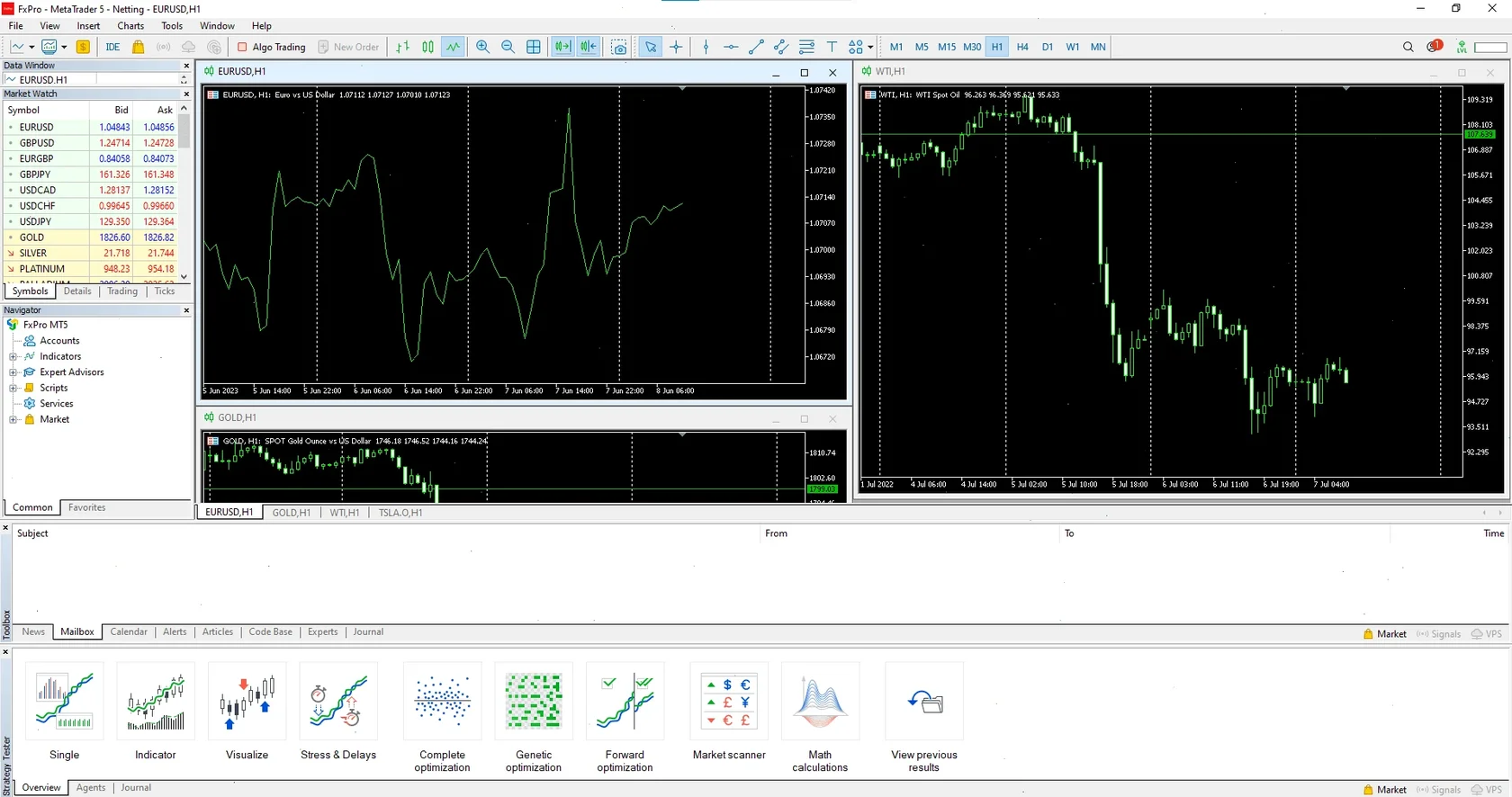
| MetaTrader 5 | Runs MQL5 Expert Advisors and includes strategy testing tools | Useful for developing and backtesting rule-based systems |
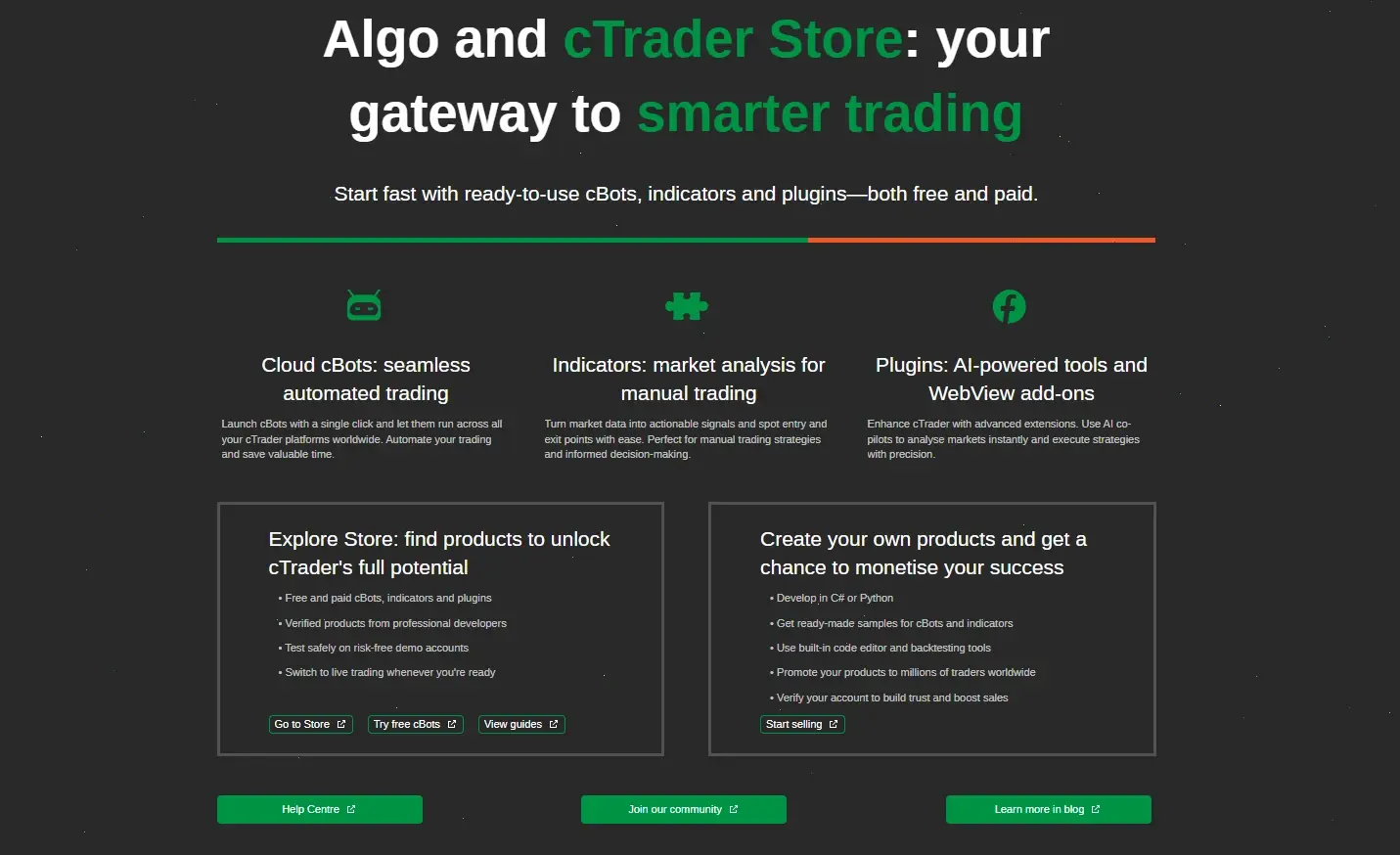
| cTrader | Supports cBots and algorithmic trading | Allows automated trade execution based on predefined logic |
| Demo account | Tests strategy behaviour without live-market capital | Useful for checking whether the bot actually follows the intended trading and risk rules |
FxPro's educational material describes EAs and cBots as programs capable of automatically opening and closing orders based on predefined parameters. They can also place pending orders and manage stop-loss and take-profit levels.
MetaTrader 5 also includes a Strategy Tester, allowing an Expert Advisor to be tested against historical price data before it is used in live trading.
This makes FxPro technically suitable for a trader who wants to combine automated or AI-assisted decision-making with a swap-free account structure. It does not mean that every CFD or automated strategy available through the broker carries the same Sharia assessment.
How to Start Halal AI Trading with FxPro
A practical setup can be divided into the account layer, platform layer and strategy layer.
- Go to the FxPro website. Start from the broker's website rather than downloading unrelated third-party bots or APK files.
- Register or log in to FxPro Direct. This is where trading accounts and available platforms are managed.
- Arrange the appropriate account structure. FxPro states that swap-free accounts for religious purposes are available on request and can have specific conditions.
- Select an automation-compatible platform. MT4 and MT5 use Expert Advisors. cTrader uses cBots.
- Create a demo account first. Use it to confirm entries, exits, position sizing, stop-loss behaviour and holding times.
- Install or build the algorithm. A simple rule-based strategy is easier to audit than a black-box system whose decisions cannot be explained.
- Set hard risk parameters. Define the percentage risked per trade, maximum open positions, stop-loss logic and maximum daily loss.
- Define time rules. If the strategy should not remain open through rollover, encode a forced closing time instead of relying on manual intervention.
- Backtest the strategy. Test how the same rules behaved across trending, ranging and volatile historical periods.
- Forward-test on demo. Backtests do not reproduce every real-time effect such as changing spreads, execution delays or slippage.
- Move to live trading only after the system behaves as designed. Use a small position size first rather than immediately increasing exposure.
How to Build an AI/cBot Strategy: Practical Example
A useful first system does not need a complicated neural network. A transparent algorithm is easier to test, debug and understand.
Consider this EUR/USD trend-following framework:
| Rule | Setting | Purpose |
|---|---|---|
| Fast trend indicator | EMA 20 | Tracks short-term price direction |
| Slow trend indicator | EMA 50 | Defines broader trend direction |
| Momentum filter | RSI above 50 for longs | Avoids entering solely because two averages briefly cross |
| Risk per trade | 0.5% to 1% | Keeps losses proportional to account equity |
| Stop-loss | 1.5 × ATR | Adjusts the stop distance to current volatility |
| Position progression | No martingale | Prevents exponential increase after losses |
| Time filter | No new entries after a defined hour | Controls when the bot can create new exposure |
| Closing rule | Close on opposite signal or predefined exit time | Prevents positions remaining open indefinitely |
Position Sizing Example
Assume the trading account contains $10,000 and the bot is allowed to risk 0.5% on a trade.
$10,000 × 0.5% = $50 maximum planned risk
If the calculated stop-loss is 25 pips away, the strategy should choose a position size where approximately 25 pips corresponds to the planned $50 loss, before allowing for trading costs and execution differences.
Now suppose market volatility doubles. ATR increases and the stop distance expands to 50 pips. A properly designed risk engine should reduce the position size rather than keep the same volume. The dollar risk can therefore remain around the same predefined limit.
This is a good example of where automation can improve discipline. The bot is not attempting to predict the future with certainty; it is consistently applying a risk formula.
Where AI Can Be Added
Once the basic rules are stable, AI can be introduced without replacing the risk controls. For example, a model could assign every signal a probability score based on volatility, trend strength, trading session and previous price behaviour.
The algorithm might then allow a trade only when:
- EMA 20 is above EMA 50;
- RSI is above 50;
- the AI confidence score is above 65%;
- risk remains at or below 0.5%;
- maximum daily loss has not been reached;
- the permitted trading time window is still open.
The AI improves filtering, while the deterministic rules continue to control exposure.
AI vs Trading Bot vs Algorithmic Trading
These terms are often used as though they mean the same thing, but they describe different levels of automation.
| Technology | How It Works | Example |
|---|---|---|
| Trading bot | Automatically executes programmed rules | Buy when EMA 20 crosses EMA 50 |
| Algorithmic trading | Uses computer instructions to analyse and/or execute a strategy | Calculate position size, enter, place SL/TP and exit automatically |
| AI trading | Uses techniques such as machine learning to classify, forecast or score market conditions | A model estimates the probability that a breakout will continue |
| Expert Advisor | MetaTrader automation program | An MQL5 EA trading EUR/USD according to predefined rules |
| cBot | Automated strategy used with cTrader | A cBot that sizes trades according to ATR |
A bot can therefore be fully automated without containing artificial intelligence. For example:
If EMA 20 crosses above EMA 50 → buy.
If price falls 25 pips → close.
If price rises 50 pips → take profit.
Those are fixed instructions. The bot does not learn.
An AI system may instead analyse thousands of historical observations and estimate that a particular crossover currently has, for example, a 68% model confidence score. Even then, the order can ultimately be executed by an ordinary algorithm.
From a Halal Trade AI perspective, this technical distinction is useful but secondary. Whether a machine learns from data or simply follows an if/then instruction does not by itself change the underlying financial contract.
Which Markets Create Different Halal Questions?
There is no single answer that can be transferred automatically from one asset class to another. Different markets introduce different ownership, settlement, financing and contract questions.
| Market | Main Halal Trade AI Question |
|---|---|
| Forex | Currency exchange, settlement, leverage and overnight interest are central issues. |
| Gold | Gold has specific Sharia rules concerning trading and possession. AAOIFI has a dedicated Sharia Standard No. 57 covering gold and gold-based financial products. |
| Stocks | Company business activities, financial ratios, ownership and the method used to obtain exposure all matter. |
| Indices | An index itself is a calculated benchmark; the contract used to trade its price must be analysed separately. |
| Crypto | Scholarly views differ considerably by asset and transaction structure. Spot ownership and derivative exposure are not the same arrangement. |
| CFDs | CFDs provide price exposure without ownership of the underlying asset, creating additional Sharia questions around contract structure, leverage and speculation. |
Forex
AAOIFI includes a dedicated standard on trading in currencies. For AI forex trading, the algorithm may determine the timing of the trade, but the currency transaction itself still has to be considered according to the rules applicable to currency exchange.
Gold
Gold deserves separate treatment because Islamic finance applies specific rules to it. AAOIFI Sharia Standard No. 57 specifically addresses gold, forms of gold, controls governing its trading and gold-based products used by financial institutions.
An AI model predicting XAU/USD therefore answers a market-analysis question, not the complete Sharia question. The way the trader obtains gold exposure still matters.
Stocks
AI is particularly useful for stock screening because thousands of companies can be filtered quickly. A Sharia-oriented model can first remove businesses outside the chosen screening methodology and then rank the remaining companies using valuation, earnings, momentum or machine-learning signals.
Indices
An index such as the S&P 500 or FTSE/JSE Top 40 represents a basket calculated according to an index methodology. Buying shares of every constituent, investing through a fund and trading an index CFD are legally different ways of gaining market exposure.
Crypto
The term “crypto trading” also covers very different structures: ownership of a token, perpetual derivatives, leveraged futures and CFD exposure are not interchangeable. An AI strategy must therefore be analysed together with the actual instrument it trades.
CFDs
FxPro primarily provides CFD trading across multiple markets. A CFD settles the difference between opening and closing prices rather than transferring ownership of the referenced asset. For readers specifically seeking Sharia-compliant investing, that distinction is significant and should not be hidden behind the broader label “halal AI trading”.
Explore Algorithmic Trading with FxProHalal Trade AI FAQ
- Is AI forex trading halal?
- Using AI to analyse forex prices or generate signals is not what determines the Sharia status of a forex transaction. The relevant issues include the currency contract, settlement, leverage, financing and whether interest-based rollover is involved.
- Is automated trading halal?
- Automation is a method of execution. A bot can automatically execute a transaction that is acceptable under a particular Sharia methodology or one that raises Sharia concerns. The automation itself does not decide the issue.
- Are trading bots halal?
- A trading bot is software. Its status depends on what it is programmed to trade and how. A bot calculating indicators and managing stop-loss orders is fundamentally different from a bot using interest-bearing financing or gambling-style position progression.
- Is cTrader halal?
- cTrader is a trading platform and automation environment, not a financial contract. It can run cBots that analyse markets and execute trades. The Sharia question applies to the account, instrument and transaction executed through the platform.
- Is MetaTrader halal?
- MetaTrader 4 and MetaTrader 5 are software platforms. They are neither a declaration of Sharia compliance nor a prohibited financial instrument by themselves. EAs running on MetaTrader inherit the economic characteristics of the trades they execute.
- Is CFD trading halal?
- CFDs raise significant Sharia questions because the trader generally receives price exposure without owning the underlying asset, and CFDs may also involve leverage, financing and highly speculative trading. A swap-free CFD account removes the conventional swap issue but does not change the basic contractual structure of a CFD.
- Is leverage halal?
- There is no single answer based only on the leverage ratio. The structure of the financing, any interest or benefit attached to the loan, and the transaction being financed are relevant. A 1:10 or 1:100 number alone cannot establish Sharia compliance.
- Is a swap-free account halal?
- A swap-free account removes the conventional overnight swap mechanism, which addresses the riba concern associated with normal rollover interest. It does not automatically make every instrument or strategy on the account Sharia-compliant.
- Can Muslims use FxPro?
- FxPro offers swap-free accounts for religious purposes and supports automated trading through MT4, MT5 and cTrader. Whether a particular trade matches an individual's Sharia requirements depends on the instrument, contract and strategy being used.
- Can AI choose halal stocks?
- Yes, AI can be used as a screening and ranking tool. A system can first filter companies according to a defined Sharia methodology and then apply valuation, momentum or machine-learning analysis to the remaining shares.
- Can AI trading involve riba?
- Yes. AI does not prevent riba. An automated system can hold a position subject to overnight interest just as a human trader can. Avoiding that outcome requires the account and strategy to be structured accordingly.
- Is day trading halal?
- Closing a trade within the same day can avoid an overnight swap, but holding time alone does not determine Sharia compliance. The asset, ownership or derivative structure, leverage and degree of speculation also matter.